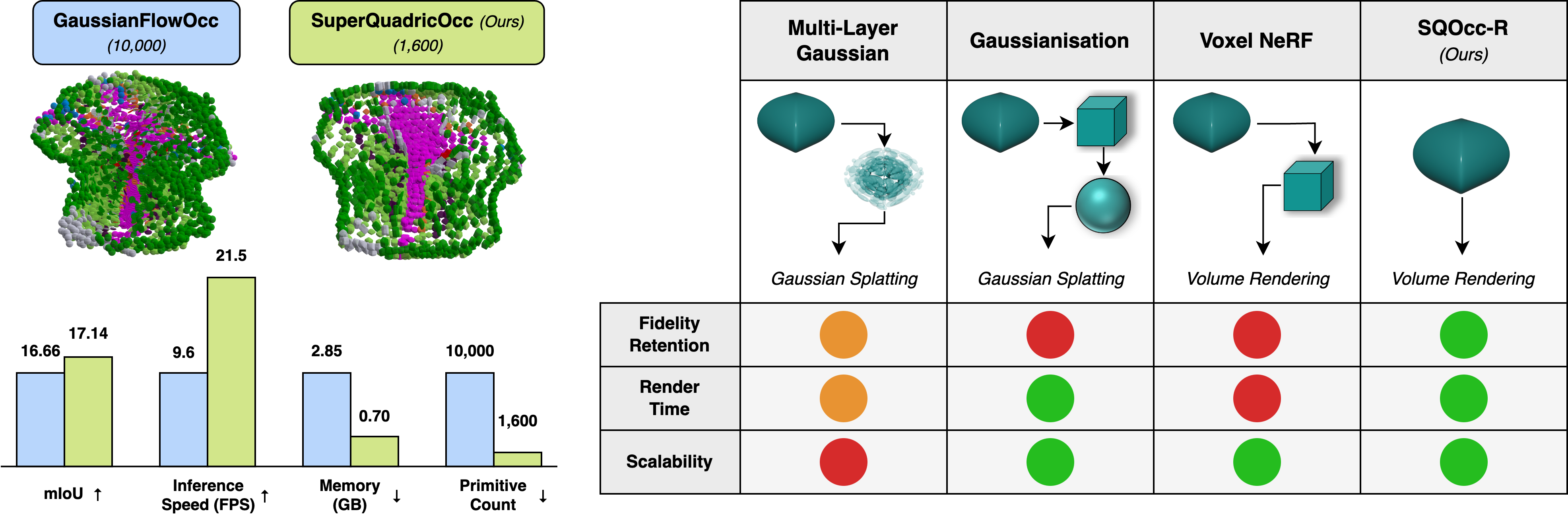
Self-supervision for semantic occupancy estimation is appealing as it removes the labour-intensive manual annotation, thus allowing one to scale to larger autonomous driving datasets. Superquadrics offer an expressive shape family very suitable for this task, yet their deployment in a self-supervised setting has been hindered by the lack of efficient rendering methods to bridge the 3D scene representation with 2D training pseudo-labels. To address this, we introduce SuperQuadricOcc, the first self-supervised occupancy model to leverage superquadrics for scene representation. To overcome the rendering limitation, we propose a real-time volume renderer that preserves the fidelity of the superquadric shape during rendering. It relies on spatial superquadric–voxel indexing, restricting each ray sample to query only nearby superquadrics, thereby greatly reducing memory usage and computational cost. Using drastically fewer primitives than prior Gaussian-based methods, SuperQuadricOcc achieves state-of-the-art RayIoU on Occ3D-nuScenes with real-time inference and a substantially reduced memory footprint, while also outperforming Gaussian-based baselines on downstream occupancy forecasting and trajectory estimation.
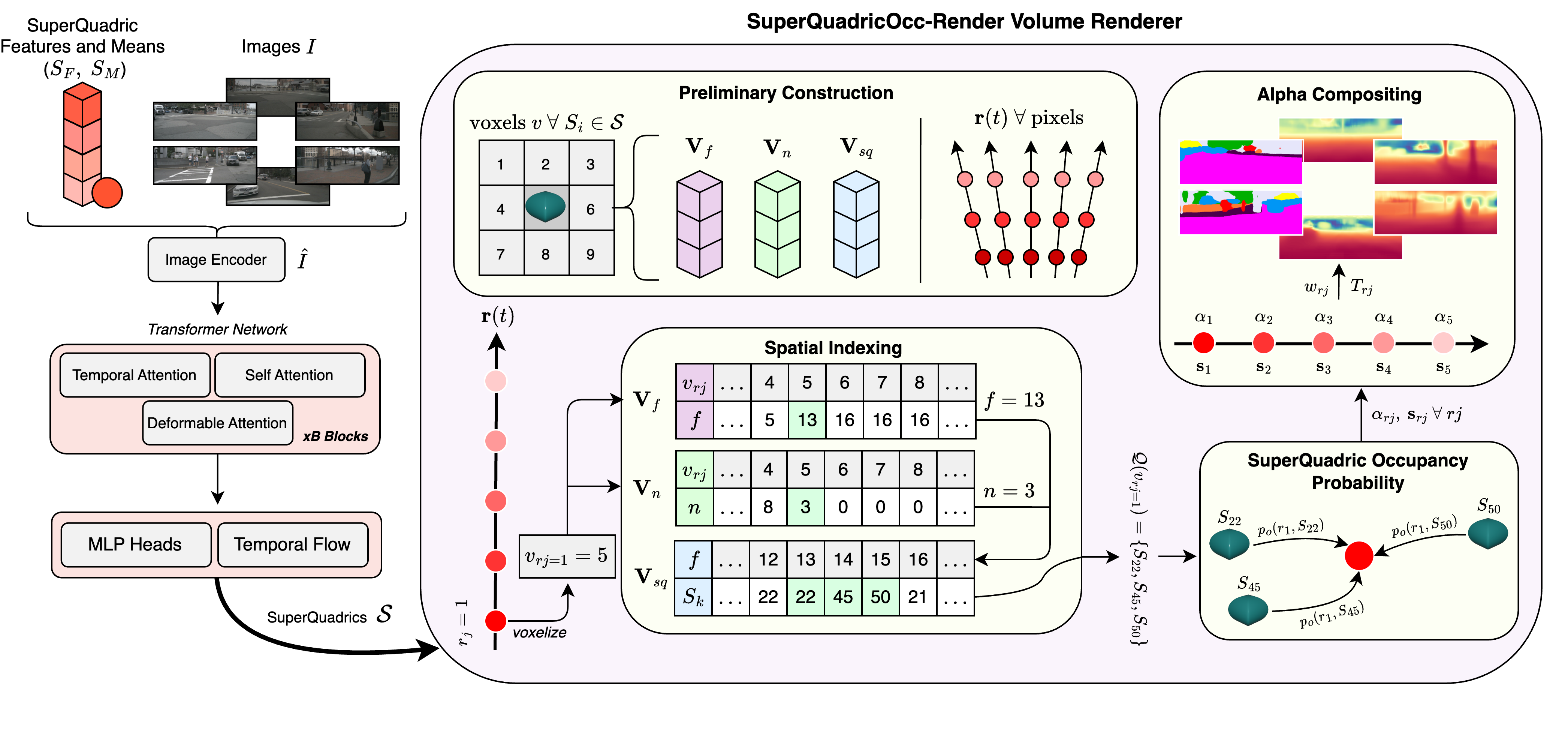
To begin, the transformer network refines superquadric means \( S_M \) and features \( S_F \), which are eventually transformed into full primitives for rendering. In SuperQuadricOcc-Render, following preliminary construction, we iterate over each ray sample \( r_j \), and query the spatial indexing tensors \( \mathbf{V}_{sq} \), \( \mathbf{V}_{n} \), \( \mathbf{V}_{f} \) to obtain the list of superquadrics \( \mathcal{Q}(v_{r_j}) \). We then compute the ray sample values \( \alpha_{r_j} \), \( \mathbf{s}_{r_j} \), and perform alpha compositing to produce the final semantic render \( \hat{S} \) and depth render \( \hat{D} \). During evaluation, superquadrics \( \mathcal{S} \) are voxelized.
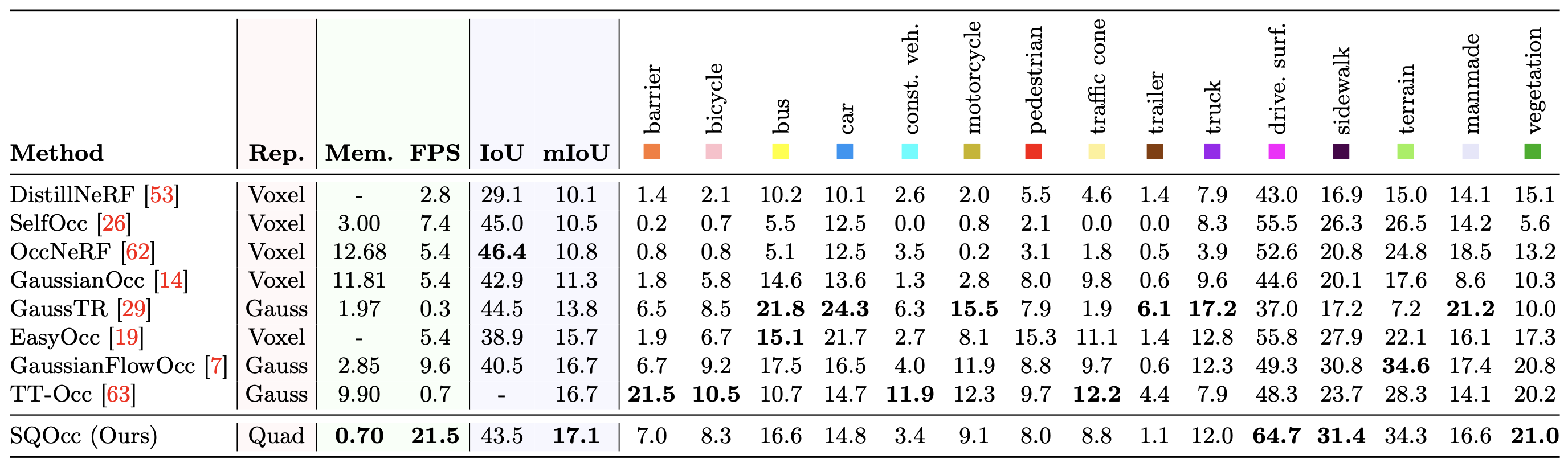
For semantic occupancy estimation, SuperQuadricOcc produces coherent predictions largely due to the use of superquadrics, which enable a more efficient scene representation. The model accurately detects both nearby and distant objects through temporal flow, addressing the bias toward regions close to the camera that affected previous methods. Furthermore, it delivers these predictions at a real-time speed of 21 FPS.
For 2D depth and semantic estimation, SuperQuadricOcc coupled with SQOcc-R produces accurate renderings. Since supervision occurs in 2D space, the method remains particularly accurate in dense scenes containing many vehicles and other objects. SQOcc-R delivers these renders at 58 FPS across all six cameras.
On the Occ3D-nuScenes and OpenOccv2 datasets, SuperQuadricOcc surpasses previous methods based on voxel or Gaussian scene representations on both mIoU and RayIoU metrics, displaying the methods ability to accurately capture the scene geometry and semantics.Furthermore, the superquadric representation enables real-time inference with low memory usage of just 0.70 GB, more than doubling FPS while halving memory usage compared to prior methods.
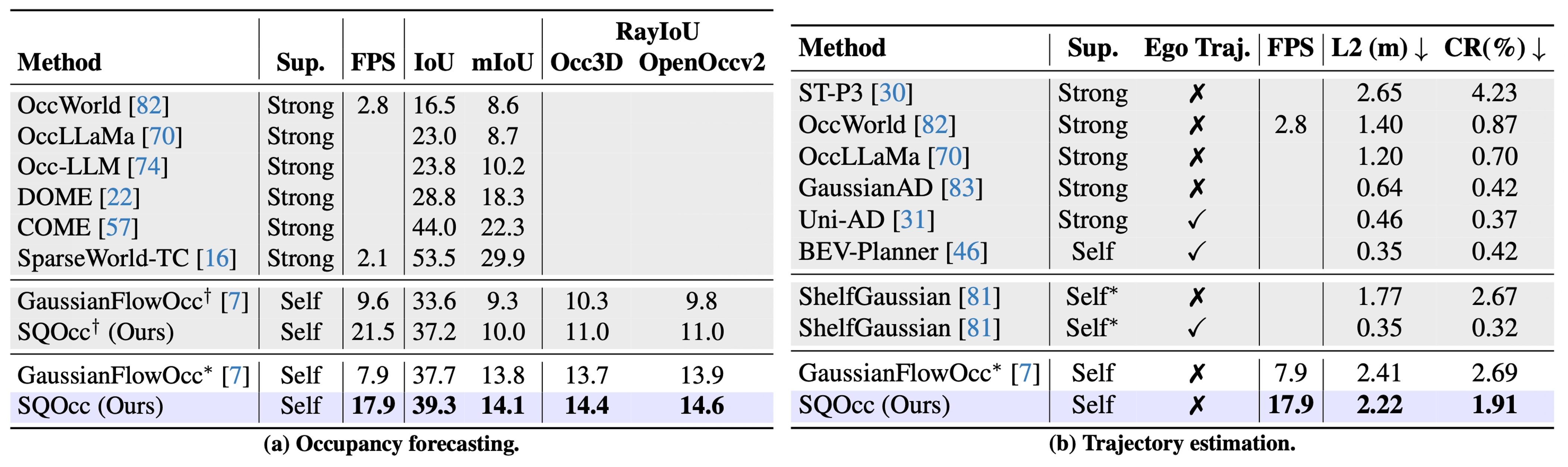
For occupancy forecasting and trajectory estimation, SuperQuadricOcc outperforms the Gaussian-based GaussianFlowOcc, demonstrating the effectiveness of the superquadric representation. Namely, for trajectory estimation, the compactness of superquadrics permits less collisions (CR metric), suggesting that the compact superquadric representation better preserves temporally useful free-space and object-extent structure than a larger set of local Gaussian primitives.
@misc{hayes2026superquadricoccrealtimeselfsupervisedsemantic,
    title={SuperQuadricOcc: Real-Time Self-Supervised Semantic Occupancy Estimation with Superquadric Volume Rendering},
    author={Seamie Hayes and Alexandre Boulch and Andrei Bursuc and Reenu Mohandas and Ganesh Sistu and Tim Brophy and
    Ciaran Eising},
    year={2026},
    eprint={2511.17361},
    archivePrefix={arXiv},
    primaryClass={cs.CV},
    url={https://arxiv.org/abs/2511.17361},
    }